Slab Leak Repair in Newport Beach, CA
Many Newport Beach homes sit on concrete slab foundations with the water lines running underneath. That design keeps the pipes out of the way, but it also means a leak has nowhere to go except up through the concrete and into the flooring above. A hot water line leak warms the floor over the break, while a cold line leak shows up as dampness, and both can run for weeks before the homeowner connects the signs to a buried pipe.
Slab leaks deserve quick attention because the water does more than wet the floor. It can erode the soil that supports the slab, crack the concrete, and feed mold in the flooring and baseboards. This page covers the warning signs, how a slab leak is located without tearing up the whole floor, the repair options, and why waiting makes the damage worse.
Warning Signs of a Slab Leak
A warm spot on the floor is the classic sign of a hot water slab leak. Walk barefoot across tile or wood flooring and feel for one area that stays warm while the rest of the floor is cool. Damp carpet, flooring that buckles, and baseboards that swell or pull away from the wall are signs of a cold line leak pushing water upward. Cracks in a tile floor or in the slab itself can also point to water moving underneath.
The water meter tells the same story from a different angle. Shut off every tap and water using appliance, then watch the meter. If it keeps turning, water is escaping somewhere, and a slab leak is the likely culprit when no wall or ceiling shows dampness. A water bill that climbs sharply with no change in household use is another strong clue, and so is the sound of running water under the floor when the house is quiet.
- A warm patch on tile or wood flooring
- Damp carpet or flooring that buckles and lifts
- Baseboards that swell or pull away from the wall
- Cracks in tile or in the concrete slab
- A water meter that moves with all water off
- The sound of running water under a quiet floor
Related: burst pipe leak detection, slab leak repair in Newport Beach
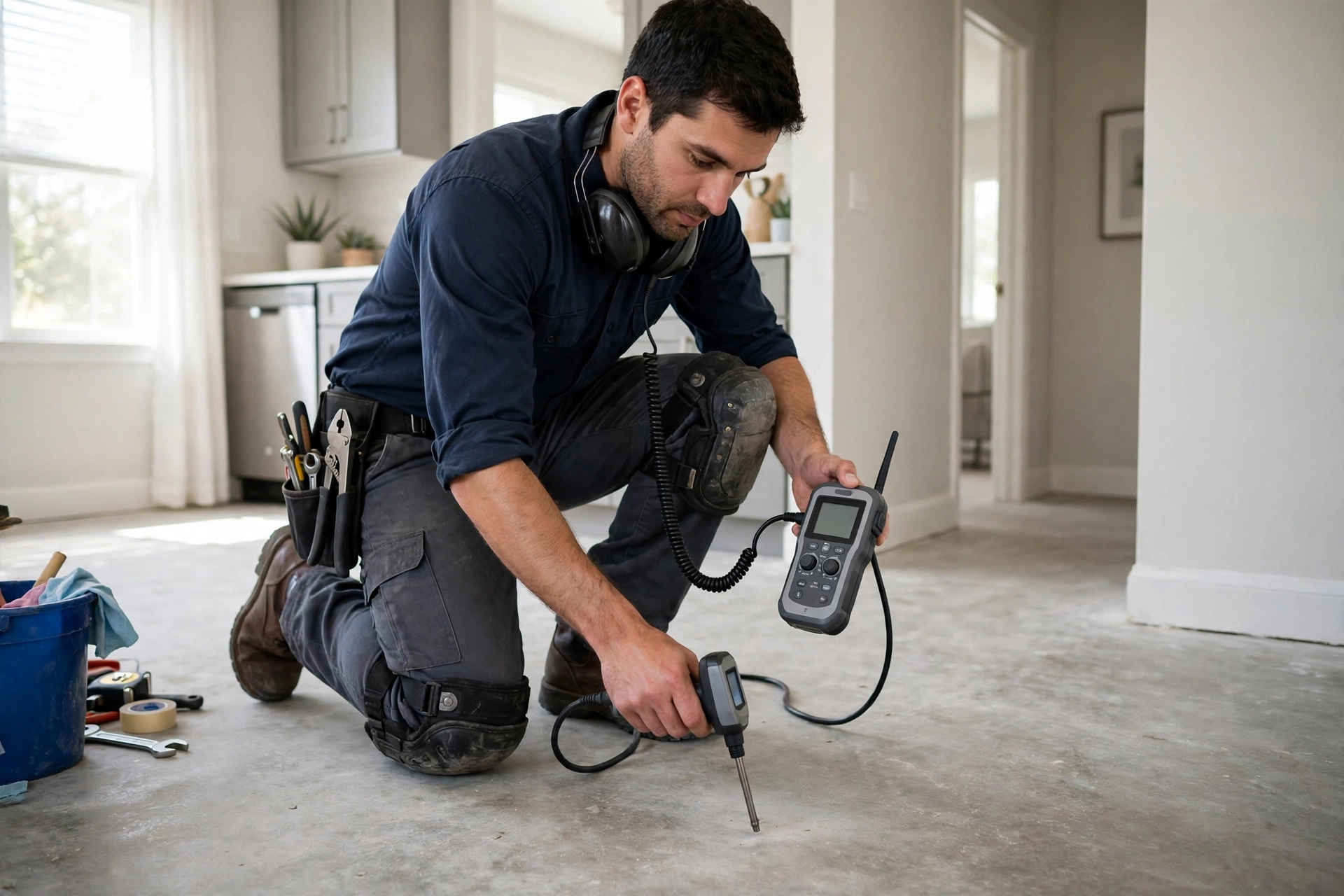
How Slab Leaks Are Located
Location starts with pressure testing. The technician isolates the hot and cold runs and watches the gauges to learn which line is losing water. Then acoustic listening equipment is placed on the floor, and the hiss of water escaping under pressure is tracked across the slab until the sound is loudest at one point. Thermal imaging adds confirmation for hot lines, showing the warm trail the leaking water leaves in the concrete.
In difficult cases a harmless tracer gas is put into the line, and a sniffer at the floor surface picks up the gas where it escapes through the break. Each method narrows the search further, and together they usually mark a spot the size of a floor tile. That precision is what keeps the repair small, because the crew knows exactly where to open the slab or where to start the reroute.
Related: emergency burst pipe repair, slab leak repair near Irvine
Repair Options for a Slab Leak
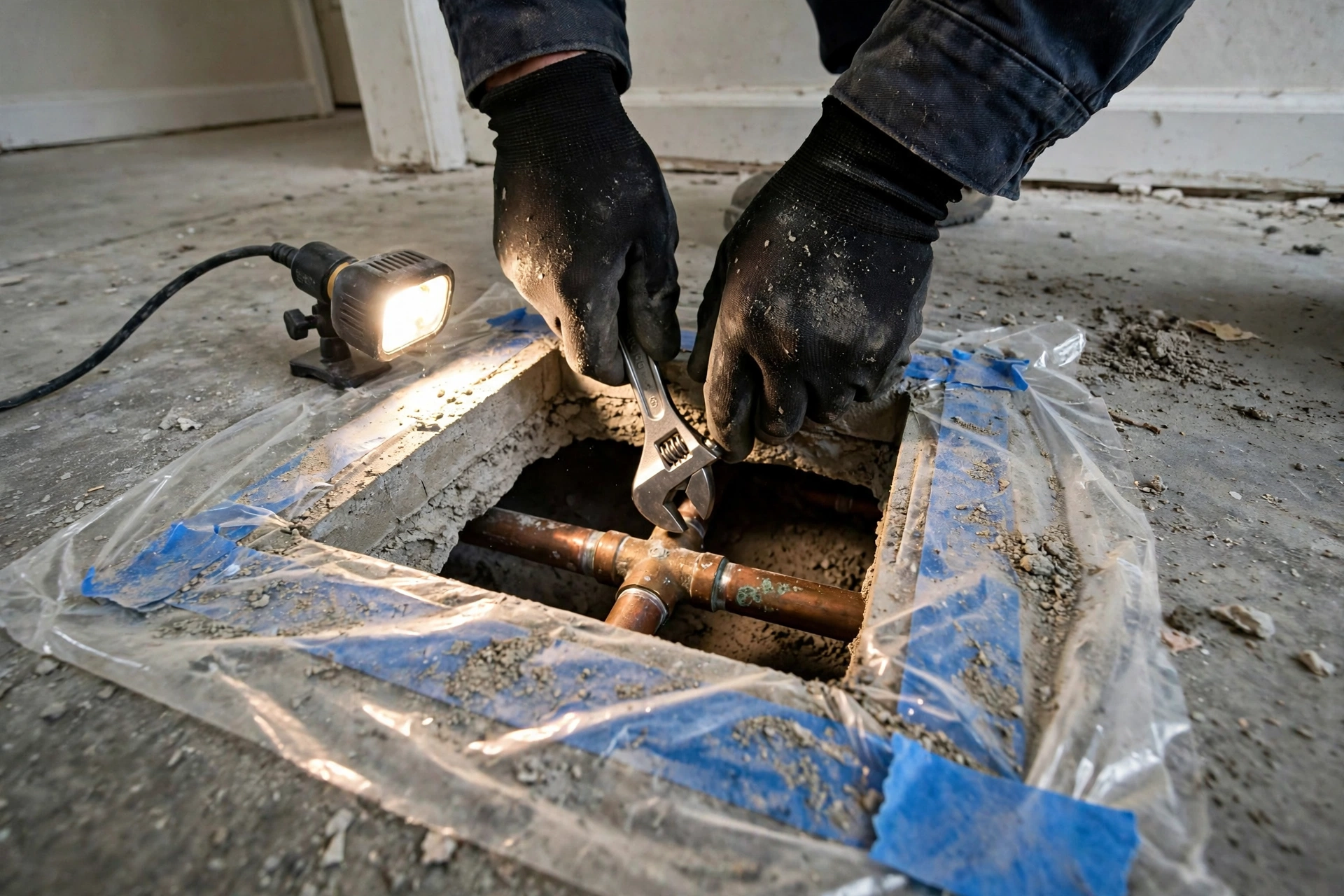
The direct repair opens the slab at the marked spot. A small section of flooring and concrete is removed, the damaged pipe is cut out and replaced, and the concrete is patched. This is the right choice when the leak is in one place, the rest of the line is sound, and the flooring above can be restored cleanly. The opening is kept as small as the repair allows, and the patch is finished so the floor can be restored over it.
The reroute leaves the slab untouched. A new line is run overhead through the attic or along the wall framing, bypassing the buried pipe entirely, and the old line is capped off. A reroute is often the better choice when the buried line has leaked before, when the flooring above is expensive to disturb, or when the slab has already been opened once. Both options end with a pressure test of the new line before the water comes back on.
Related: repiping an older home, water line repair
Why Slab Leaks Need Attention Right Away
Water under a slab does not stay still. It follows the gaps in the soil, washes fine material away, and leaves voids beneath the concrete. Over time the slab can settle or crack over those voids, and the repair grows from a pipe fix into a foundation problem. The water also rises into flooring, baseboards, and wall bottoms, where it feeds mold and rots wood framing that is hard to reach.
The longer a slab leak runs, the more water is lost and the more material it damages. A leak that starts as a warm spot on the floor can end as warped flooring across a room, a cracked slab, and a mold problem in the walls. Acting on the early signs, a warm floor, a climbing water bill, or a meter that never stops, keeps the job a pipe repair instead of a restoration project.
Related: burst pipe cleanup and water damage, slab leak repair in Corona del Mar
How Slab Leaks Differ From Other Hidden Leaks
A leak inside a wall and a leak under a slab behave very differently. A wall leak soaks drywall and insulation, and the stain usually appears close to the break, so the search area is small. A slab leak soaks concrete and soil, and the water can travel sideways under the slab before it rises, so the damp patch on the floor may sit far from the actual break. That is why slab detection leans on listening equipment and pressure testing rather than on visible stains.
The repair choices differ too. A wall leak is reached by opening drywall, which is quick to patch and easy to restore. A slab leak is reached by opening concrete, which is heavier work and needs a proper patch, or by rerouting the line overhead so the slab is never opened at all. The reroute option exists because the pipe under the slab is hard to reach, and for many homeowners it is the cleaner answer.
The stakes are higher with a slab leak because the foundation is involved. Water under a slab can wash away the soil that supports the concrete, and a slab that loses support can settle or crack. A wall leak threatens drywall and framing, which is serious, but a slab leak threatens the base the whole house sits on. That difference is why a warm floor or a climbing water bill should be checked promptly rather than watched for another month.
The warning signs differ as well. Wall leaks show stains, bubbling paint, and swollen baseboards. Slab leaks show warm patches on the floor, damp carpet with no wall stain, and cracks in tile or concrete. Learning the slab signs matters in Newport Beach, where slab foundations are common and the pipes beneath them are out of sight. A homeowner who knows what to feel for underfoot can catch a slab leak while it is still a pipe repair.
- Wall leaks stain near the break, slab leaks travel under concrete
- Slab detection relies on listening and pressure testing
- A slab leak can be fixed by opening concrete or by rerouting
- Water under a slab can erode the soil that supports it
- Warm floors and damp carpet are the key slab signs
Related: burst pipe leak detection, water line repair
Slab Leak Repair Questions, Answered
Not seeing your question? Request service and describe what is happening.
A warm patch on the floor, damp carpet, buckling flooring, swollen baseboards, cracks in tile or concrete, a water bill that jumps, and a meter that moves with all water off. The sound of running water under a quiet floor is another sign.
Pressure testing first identifies which line is leaking. Acoustic listening equipment then tracks the sound of escaping water across the slab, and thermal imaging confirms hot line leaks. The break is marked before any concrete is opened.
Yes. A reroute runs a new line overhead through the attic or wall framing and caps off the buried pipe, so the slab is never opened. A direct repair through the slab is the other option and suits a single leak in a sound line.
Very urgent. Water under a slab erodes the soil that supports the concrete, and it rises into flooring and walls where it feeds mold. Early action keeps the job a pipe repair instead of a foundation and restoration problem.
Yes. A slab leak runs constantly, so the meter keeps turning around the clock. A bill that climbs sharply with no change in household water use is one of the most reliable signs of a buried leak.
Yes. Water under a slab can wash away the soil that supports the concrete, and a slab that loses support can settle or crack. Early detection keeps the job a pipe repair instead of a foundation problem.
Related Burst Pipe Services
Emergency Burst Pipe Repair
A burst pipe in a Newport Beach home needs water shut off first, then a plumber to find the break, stop the fl...
Learn MoreBurst Pipe Leak Detection
Hidden leaks behind walls, under floors, and inside concrete slabs rarely announce themselves with spraying wa...
Learn MoreCopper Pipe Repair
Copper has carried the water in most Newport Beach homes for decades, and near the coast it eventually corrode...
Learn MoreSlab Leak Repair in Newport Beach, CA
A slab leak is a break in a water line buried under the concrete slab a home sits on, and it is one of the hardest leaks to spot because the pipe is hidden completely. The signs are indirect: a warm patch on the floor, damp carpet, a water bill that jumps, or the sound of water running when every tap is off. Slab leak repair locates the break with listening equipment, then fixes it by opening the slab at one marked spot or by rerouting the line overhead.
Get Help From a Local Specialist
Request service and a local burst pipe contractor will help.
Call Us
Emergency burst pipe help across Newport Beach.
Phone number to be decidedEmail Us
Send questions about a leak or repair.
Email address to be decidedVisit Us
Proudly serving Newport Beach and the Orange County coast.
Address to be confirmed